|
|
This entry has three pages:
|
|
|
|
The Orcs
|
|

[Click for a larger image]
|
"... Then there was an echoing blast: a great horn was
blown in the hall, and answering horns and harsh cries
were heard further off. There was a hurrying sound of
many feet. ..."
"... There was a rush of hoarse laughter, like the falls
of sliding stones into a pit; amid the clamour a deep
voice was raised in command. ..."
"... 'There are Orcs, very many of them,' (Gandalf) said.
'And some are large and evil: black Uruks of Mordor. For
the moment they are hanging back, but there are something
else there. A great cave-troll, I think, or maybe more
than one. There is no hope of escape that way.' ..."
|
J.R.R.T, The Lord of the Rings;
The Fellowship of the Ring, Book II,
"The Bridge of Khazad-Dum"

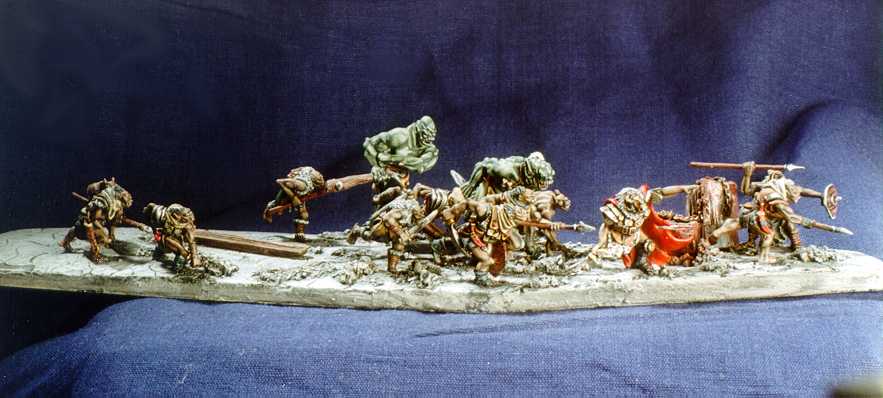
When I picked out the orc and troll miniatures I
had a few things in mind. First, I wanted them to
be running as if full of determination not to cross the
balrog and to bear down on some unknown enemy ahead of
them and outside the scene. Secondly I wanted those closest
to the balrog to be looking as if covering for it while
still keeping a good pace. Third I wanted them to look
culturally coherent as if they were from the same tribe.
Chris Tubb at Mithril Miniature has written a couple of
outlines on how he pictures orcs in different parts of
Middle Earth.
"The mountains of the Hithaeglir are riddled with
Goblin tunnels from Gundabad in the north to Moria
and this foul race increasingly infest the Misty
Mountains. They are dressed in wolf-pelts, a feature,
which distinguish them from southern orcs, and wear fur
bindings about their legs. They usually go barefoot though,
and are sure and agile climbers. The wolf is a totem
animal amongst the Hithaeglir orcs and these figures
carry its symbol on their shields. One orc wears a
necklace of Wargs teeth, which is believed by them
to transfer the savagery and strength of that creature to them."
This text is pretty much consistent with the Hithaeglir
orc outline in the first Mithril Handbook and I feel
they are quite good thematic extrapolations for
establishing some cultural differences between orcs of
different areas. Even though it is stated in several places
that Sauron had sent Mordor orcs to Moria, I doubt Sauron
had a real grip of the place. I would rather believe the
balrog was the uncontested dark lord of the deep tunnels
and I doubt it was ever under Sauron's sway. The Mordor
uruk-hai in Moria were probably there to ally with the
balrog's hordes and also serviced as informants to
Sauron. But as I picture it the majority of the orcs
the balrog had gathered around itself were of the
Misty Mountains goblin stock.
Luckily, I still have quite a lot of unpainted orcs and
I had not any significant problems finding enough orcs to
fit the criteria I have mentioned above; running orcs and
covering orcs, all with different degrees of wolf pelt items
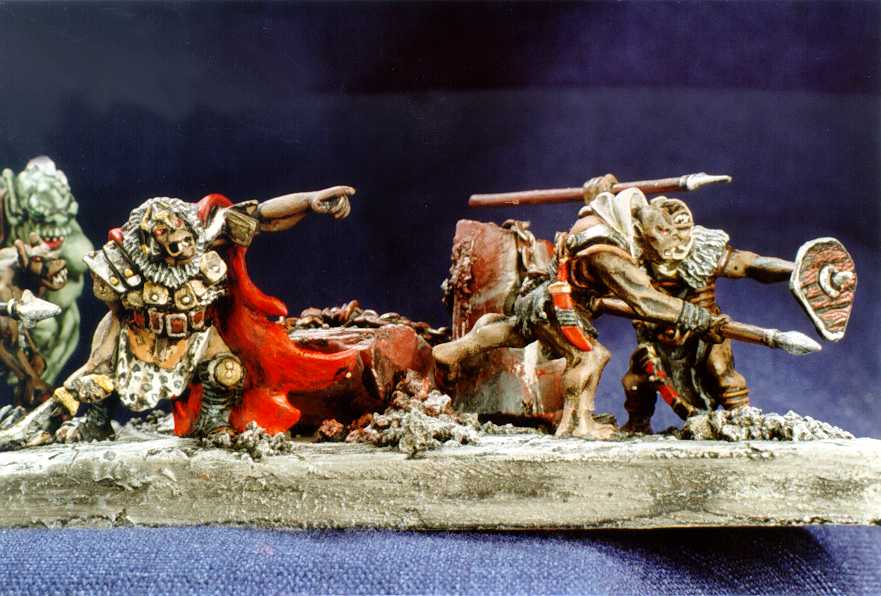
on them. I also threw in some odd orcs in specific poses: an
orc chieftain pointing out the direction of horde's rush, a
goblin emerging from the portal and an archer on a ledge. These
miniatures are from a number of releases and are numbered as
follows: M20, M21,
M22, M98 (a and b),
M222 (a and b), M288 (a and b),
M308 (a and b) and two figures from the MW336 Orcs of Mordor box.
Behind the orcs I have placed two great big lumbering
trolls; dimwitted but savagely cruel creatures that wade
through the horde of orcs, single-mindedly knocking anything
of its feet should it stand in their path. They wield
crude but vicious weapons of simple wood and rock and are
dressed in uncured hides and bones of their victims adorn
their hulking bodies. Tolkien mentions about seven different
types of trolls in his stories, but it was cave trolls the
Fellowship encountered in the chamber of Mazarbul in Moria.
As we read in the LotR, 'The Bridge of Khazad-Dum':
"There was a blow at the door that
made it quiver; and then to began to grind slowly open, with
driving back the wedges. A huge arm and shoulder, with a dark skin of greenish scales,
was thrust through the widening gap. Then a great, flat,
toeless foot was forced through below."
Well, the miniatures
I have painted are not toeless; they have huge clawed feet but
I feel that's perfectly all right. Traditionally trolls can come
with a varying amount of fingers, toes, limbs and heads. These are
not sculpted visibly scaly, and I partly wish I had thought of
painting them scaly instead. But green they are, a color I have
chosen to believe is typical for cave-trolls.
The troll miniatures come from two series: the M174 of the "Ghost
Warriors of the Dunfearen" and M284 from "The Chamber of Mazarbul".
When I paint orcs I have ever since I started doings so
given them a dark greyish brown skin. Orcs can probably
be imagined to be in any color from pale grey to completely
black (especially the uruk-hai), and they were probably not
even consistently colored. I have chosen to paint them the
same since it often has the best effect if you want to make
them look as if they belong to one unit. (That's of course
the fancy explanation; it's also because it takes less time
to paint them that way.) When painting orc garments one has
to think one or two times before setting out to do so. In my
imagination orcs wear an assortment of filthy rags and half
decomposed fur and care little about fashionable colors. This
means most of them will be in drab colors like browns, greys and
black. The problem is that if these colors lay very close to each
other on the color scale and if not chosen and lain out carefully
the miniature will look very dull and uninteresting. So what you
should do is to choose alternatively lighter and darker colors so
that the garments bordering to each other and the skin contrast. An
example could be to paint the hood of an orc in light khaki, the
harness in dark brown leather with a light grey, wolf pelt loincloth.
The light khaki will then frame the darker face, the wolf fur will line
the harness and contrast against the dark arms and legs. I think Chris
Tubb has made a very good job when sculpting his orc
armor. In the Hobbit the following is said about
goblins:
"They make no beautiful things, but they make many clever
ones. They can mine as well as any but the most skilled dwarves,
when they make the trouble, but they are usually untidy and dirty.
Hammers, axes, swords, daggers, pickaxes, tongs and also instruments
of tortures they make very well, or make other people to make to their
design, prisoners and slaves that have to work till they die for the want
of air and light."
Chris' orcs have crude but apparently efficient armor
and weapons. These torn ring shirts, dangling metal plates and iron bands
also helps to add some contrast and interest to the miniatures, if painted
and highlighted in appropriate metals. I allow myself to paint certain minor
items, like the sheets and handles of daggers and pouches a little brighter
just to add a splash of color and contrast.
I find it likely that orc chieftains reach their position through brute force
and evil cunning, and these power allowed them (in a rather Darwinistic way)
the pick of the armor and loot. The orc chieftain seen in these pictures has
unlike the others an iron helm and was also given a dirty red cloak and a
snow leopard loincloth to further denote his rank. I have no reference to the existence
of snow-leopards in the Misty Mountains, so it is my personal contribution
to the Middle Earth fauna.
Go to:
["Moria: Architecture"]
["Moria: 'Durin's Bane'"]
Back to the top
Back to Scenes from Middle Earth
Peder Hammarskiold ph@shapingmiddleearth.com
Copyright Peder Hammarskiold 1999 All rights reserved.